
What Does "Faith-Based Coaching" Actually Mean?
- Braylon Hancock
- May 28
- 4 min read
Updated: 7 days ago
In a culture obsessed with performance, we're focused on identity through Christ.
As I talk to more people about Bison Hitting Academy, one of the most common questions I've gotten is"
"What do you mean by faith-based coaching?
And honestly, that's a fair question.
Because when some people hear "faith-based," they may wonder if that means baseball takes a backseat to sermons, or if its just a baseball lesson with an inadvertent scripture written on the wall.
That's not what it is.
Bison Hitting Academy is first and foremost about helping kids become better hitters and better baseball players. We work on swing mechanics, approach, confidence at the plate, body movement, timing, balance, and all the fundamentals that matter in swing development.
But I also believe baseball is one of the greatest tools in the world to teach kids lessons that go far beyond the game.
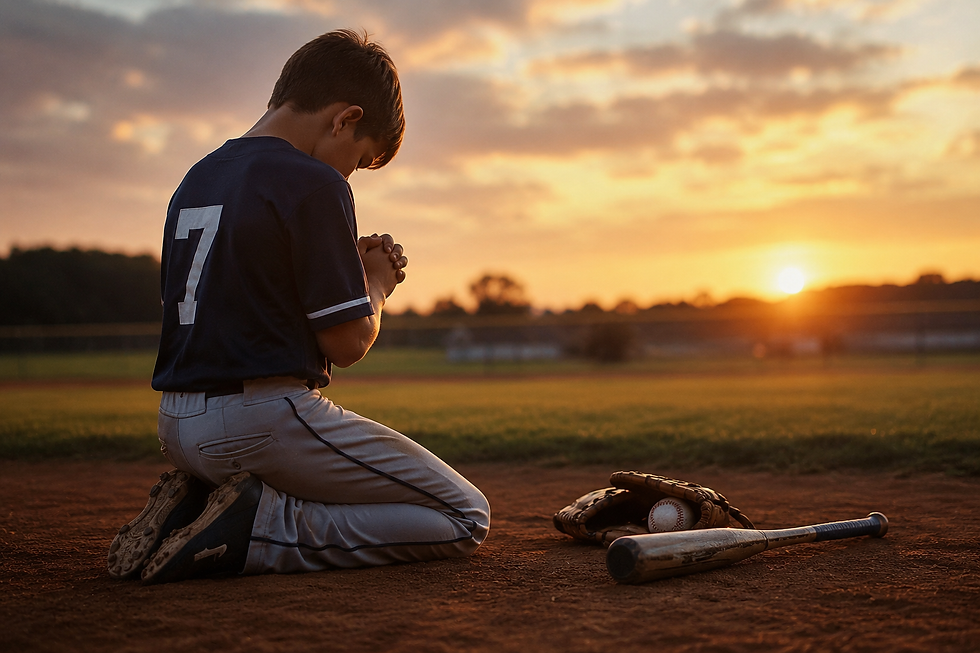
Every session I coach starts with prayer - not as a routine checkbox, but because I genuinely believe kids need to learn how to bring pressure, nerves, failure, success, and gratitude to God.
My hope is that prayer becomes something natural for them, not something they only hear about on Sundays or turn to when life gets hard. Baseball creates so many emotional moments for kids, and I want them to understand early on that they don't have to carry those things alone.
And every session has a "verse of the day" that connects directly to the lesson we're working on.
For example, one day I was working with a young athlete on the importance of keeping their eye on the ball, and watching it all the way into the bat. The verse we tied into that lesson was Matthew 14:29-30, when Peter steps out of the boat and walks on water toward Jesus, but begins to sink when he takes his eyes off Him.
The lesson was simple: What you focus on matters.
In baseball. And in life.
One of my favorite parts of each lesson is handing every player a different Into the Storm card before each lesson. Each card is built around a specific situation a young athlete is likely to face—When I make a mistake, When I compare myself, When I feel anxious or afraid, When nobody is watching, etc. On the back is a Bible verse, a simple explanation of the lie they may be tempted to believe in that moment, the truth God says instead, and a short prayer they can use before their next pitch or next swing.
My goal is for every player to leave with something they can hold onto long after the lesson is over—not just a better swing, but a reminder of who they are and where their confidence comes from.
Because if I'm being honest, I think a lot of kids today are carrying way more pressure than they should.
Youth baseball has become incredibly comparison-driven.
One kid gets a $700 bat and another kid suddenly feels like he needs it to be good.
Kids compare batting averages, rankings, teams, social media likes, tournament rings, and performance constantly.
Parents - often with completely good intentions - can accidently create pressure too by pushing kids towards things they may not fully enjoy anymore.
And travel baseball, in many ways, has become heavily monetized.
Families spend thousands of dollars chasing tournaments, rankings, exposure and plastic rings that often lose their meaning by the next weekend.
Now don't get me wrong - some of my best memories growing up came from travel baseball. The hotel stays with teammates, team dinners, late-night laughs at the pool - those are core memories I'll always treasure.
But I also think youth sports are missing a massive opportunity right now.
An opportunity to help strengthen kids spiritually. An opportunity to help kids handle adversity, pressure, success, failure, and comparison in a healthier way.
That's the kind of environment I want Bison Hitting Academy to be.
When a kid leaves one of my sessions, yes, I want them to feel like they improved mechanically.
But more than that, I want them to feel lighter.
More confident. More grounded. More equipped for adversity.
I want them to walk away with something they can carry into the rest of their life.
If a kid has a great game, I want him to remember that success isn't about statistics or attention. I want him thinking about how he treated teammates, how he handled himself, and whether he stays humble in the process.
One verse I coach with that is Deuteronomy 8:17-18:
"You may say to yourself, 'My power and the strength of my hands have produced this wealth for me,' but remember the Lord your God, for it is He who gives you the ability..."
Baseball is a gift.
Talent is a gift.
The ability to compete is a gift.
And I want kids to understand that their value doesn't rise and fall with their batting average.
Personally, part of why this matters so much to me is because I've watched the pressure culture around youth sports continue to grow.
I've seen parents post videos of their kids' swings online asking strangers to critique them publicly.
Even if those intentions are good, I think we have to ask ourselves what kind of pressure and anxiety we may unintentionally be placing on kids.
We live in a culture that doesn't eliminate pressure for young athletes anymore. It creates it.
And as a Dad myself, I feel a responsibility to help shift that narrative however I can.
I'm far from perfect, and am not the most talented baseball player. I'm still learning. Still growing. Still building the plane while I fly it a little bit.
But my desire behind this is genuine.
I'm trying to become the best coach, husband, and father I can be by walking as closely with Jesus as I can.
And if that journey can positively impact even a handful of kids along the way, then this is all worth it.

Comments